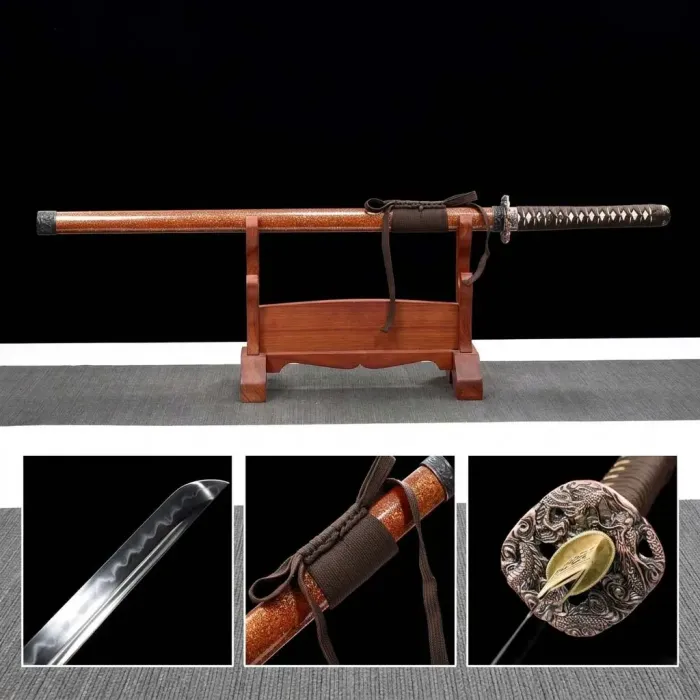
A classic nihonto represents a splendid creation of artistry, but what if you seek to express your own style? Tailoring your weapon is a significant journey, allowing you to craft a truly singular piece. From the tsuka wrapping and clasp to the tsuba design and tempering curve, each element offers a chance for tailored look. This study delves into the territory of katana modifications, providing guidance for both starters and experienced enthusiasts desiring to make their signature on the heritage art of the samurai.
Entry-Level Certified Craftsmanship
For enthusiasts ready to embark on the advantageous journey of eastern weapon training , 1060 steel katanas present an outstanding entry point. This chosen grade of fundamental steel hits a optimal point between economical cost and performance . While not quite as hard as upper-echelon steels, 1060 grants a moderate level of sharpening , making it perfect for newcomers to acquire the preliminaries of sword maintenance and experience the grace of genuine Japanese weaponry. It’s a superb choice for establishing experience without the fiscal burden of more premium steels.
T Gear Steel Cutlasses: Combining Performance and Affordability
For hobbyists seeking an authentic sword experience without exceeding the budget , T10 alloy katanas represent a compelling option. These tools offer a substantial improvement in robustness compared to middling alternatives, exhibiting satisfactory edge retention and satisfactory flexibility for primary hacking techniques. While not rivaling the excellent characteristics of elite steels like T100 or folded material , T10 provides a worthwhile blend of performance and value , making them a well-liked choice for trainees and those on a controlled earnings .
Transcending the Blade : Enhancing Your Weapon's Ornaments and Hilt
Although the glazed metallic edge is undeniably the core point of a katana, truly enhancing its beauty lies in the precise customization of its accessories and grip . This operation allows craftsmen to demonstrate their unique design . Reflect on the vast possibilities: menuki - decorative embellishments that add visual charm ; the hamon shields – often artistically sculpted ; the tsuka heart itself, wrapped in conventional ito lace ; and the fusa cap, which can be fashioned from various materials like ingots or antler .
- Adopt ideas that relate with you.
- Try with various components .
- Accent durability for a stable statement .
The Charm of the Katana: Heritage, Workmanship, and Metal
Such katana retains a incomparable allure, steeped in ages of Asian history and ancestry. More than merely a implement of military action , it's a symbol of the fighter ethos – a fusion of competence and discipline . Its advancement spanned countless generations, with early blades evolving into the refined curvature and dangerous edge we understand today. The artistry involved is truly exceptional , requiring spans of preparation to perfect . The process involves a detailed folding of wrought steel , creating layers that augment the sword’s flexibility and cleaving ability. Several schools of manufacturing developed , each with their particular secrets and processes for achieving the optimal harmony and cleanness - a truly heavy pursuit.
- Early Katana shapes
- The purpose of the samurai blade in fighter class culture
- Heritage fabricating procedures
Determining the Fitting Steel for Your Weapon Project: 1060 vs. T10
Choosing the correct steel is absolutely important for any katana project, and the decision between 1060 and T10 can be tricky. 1060 is a well-known American metal, offering a reasonable balance of toughness and hardiness, samurai sword rendering it somewhat easy to process. However, T10, a Nipponese steel, commonly boasts enhanced wear longevity and can possibly achieve a greater ultimate hardness, although it can be more tough to apply and requires detailed heat forging. Consider your competency and targeted characteristics: for a newcomer, 1060 may be a more origin, while the expert smith might value the supplementary attributes of T10.
- Convenience of Working
- Longevity
- Terminal Tenacity
Discovering Power: Refined Katana Adaptation Practices
Advancing competence in blade refinement extends far beyond basic buffing. Serious smiths are now researching advanced techniques to truly activate a blade's hidden potential. This includes intricate work with the heat signature, utilizing specialized ingredients for differential heat treating and carefully nominating the contour of the hand guard to optimize balance and functionality. Beyond purely functional changes, artisans are increasingly focused on achieving unparalleled aesthetic elegance, through complex engraving and layered glazes that truly transform a katana into a showpiece.
Shaping Rough Steel into Perfection: Making a 1060 Sword
The journey begins with regular 1060 steel , a strong material far away the deluxe katana it will transform . Proficient bladesmiths utilize a sophisticated process of folding and hammering the raw steel, repeatedly burning it and flattening it to extract impurities and build a uniform grain structure. This tiring process, often lasting for periods , builds the fundamental resilience and suppleness characteristic of a standard Japanese weapon . Supplementary heat treatments , including exact hardening and curing , are critical to achieve the specific proportion of sharpness, stability and elegance .- Combining: Diminishes impurities and constructs grain structure.
- Shaping: Designs the steel into the initial blade form.
- Curing: Regulates the final hardness and flexibility.
The Lasting Drawing of the Katana: An In-Depth Look at Metal and Personalization
This time-honored katana survives a powerful symbol within Japanese tradition , its attraction far outstripping mere military gear. Forged from tamahagane steel and frequently featuring intricate embellishments , the practice of creation itself is a esteemed art. Beyond the crucial craftsmanship, the ability to alter a katana - from the temperation to the grasp wrapping and sheath - facilitates for a truly individual expression for both enthusiasts and users alike. This blend of time-honored steelwork and boundless personalization results in the katana's continued prominence across the planet .