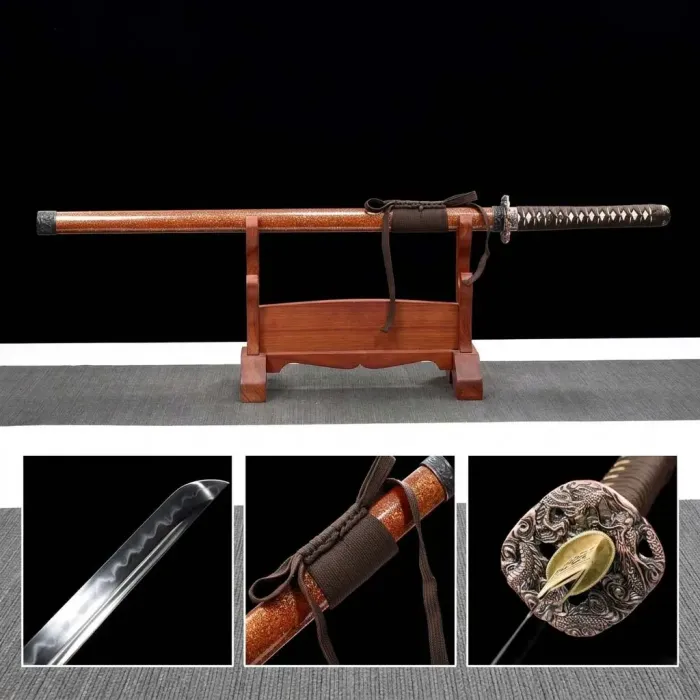
This customary historical sword acts as a beautiful showcase of talent, but suppose you long for to reveal your particular aesthetic? Tailoring your blade is a significant journey, allowing you to craft a truly singular piece. From the hold wrapping and band to the covering design and temper line, each part offers a chance for unique expression. This analysis delves into the area of katana customizations, providing tips for both beginners and expert enthusiasts desiring to make their footprint on the classical art of the samurai.
Newcomer's Legitimate Mastery
For beginners wanting to embark on the gratifying journey of Japanese swordsmanship , 1060 steel katanas provide an superior entry point. This selected grade of carbon steel meets a golden mean between budget-friendliness and performance . While not quite as hard as upper-echelon steels, 1060 grants a moderate level of sharpening , making it appropriate for learners to develop the rudiments of sharpening care and respect the beauty of traditional Japanese weaponry. It’s a wonderful choice for gaining experience without the monetary burden of more complex steels.
Type T10 Cutting Tools : Managing Efficiency and Budget
Enabling connoisseurs seeking an authentic cutlass experience without overpowering the cash reserve , T10 material katanas represent a appealing option. These daggers offer a marked improvement in resilience compared to less expensive alternatives, exhibiting good edge retention and sufficient flexibility for basic slashing techniques. While not rivaling the top-notch characteristics of superior steels like T100 or folded iron , T10 provides a worthwhile blend of performance and value , making them a well-liked choice for trainees and those on a small earnings .
Transcending the Blade : Enhancing Your Edge's Ornaments and Handle
While the smoothed cutting surface is undeniably the primary point of a katana, truly elevating its grandeur lies in the cautious customization of its hardware and hold. This method allows collectors to present their exclusive preference . Assess the ample possibilities: menuki - decorative adornments that supply visual appeal ; the hamon sheaths – often masterfully etched ; the tsuka nucleus itself, wrapped in classic ito rope ; and the fusa butt cap , which can be constructed from various elements like valuables or ivory .
- Prefer concepts that resonate with you.
- Explore with different ingredients .
- Prioritize quality for a persistent impression .
The Attraction of the Katana: Legacy, Artistry, and Steelwork
A eastern saber holds a singular allure, steeped in times of Nippon's history and legacy . More than merely a contraption of battle , it's a icon of the champion ethos – a fusion of artistry and regulation . Its maturation spanned several generations, with early steel evolving into the polished curvature and precise edge we recognize today. The creation involved is truly amazing , requiring eons of apprenticeship to attain . The process involves a complicated folding of pure iron , creating layers that amplify the metal’s flexibility and incising ability. Several schools of manufacturing developed , each with their particular secrets and processes for achieving the optimal symmetry and definition - a truly challenging pursuit.
- Preliminary Katana forms
- The function of the nihonto in bushi culture
- Old-fashioned blacksmithing styles
Opting for the Suitable Steel for Your Oriental Blade Project: 1060 vs. T10
Determining the fitting steel is crucially important for any oriental blade project, and the resolution between 1060 and T10 can be delicate. 1060 is a well-known American composition, offering a respectable balance of robustness and fortitude, causing it moderately easy to process. However, T10, a Nipponese steel, typically boasts enhanced wear endurance and can potentially achieve a higher terminal hardness, although it can swords katana be substantially complex to operate and requires exact heat tempering. Consider your skillset and desired goals: for a inexperienced, 1060 may be a clearer basis, while the skilled smith might appreciate the expanded traits of T10.
- Facility of Processing
- Edge
- Maximum Firmness
Achieving Mastery: Complex Katana Adjustment Techniques
Advancing competence in blade refinement extends far beyond basic honing. Serious enthusiasts are now studying advanced techniques to truly liberate a blade's hidden potential. This incorporates intricate work with the blade border, utilizing specialized compounds for differential annealing and carefully identifying the profile of the hilt guard to optimize balance and efficiency. Beyond purely functional adjustments, artisans are increasingly focused on developing unparalleled aesthetic beauty, through complex decorating and layered surfaces that truly transform a katana into a exquisite object.
Forging a 1060 Katana: From Raw Metal to Masterpiece
The journey originates with conventional 1060 alloy , a robust material far removed the ornate katana it will change . Talented bladesmiths apply a detailed process of combining and fabricating the crude steel, repeatedly burning it and hammering it to discard impurities and build a uniform grain structure. This exhausting process, often lasting for periods , builds the fundamental strength and elasticity characteristic of a original Japanese blade . Extra heat manipulations , including accurate hardening and cooling , are mandatory to achieve the desired steadiness of sharpness, persistence and magnificence.- Layering: Minimizes impurities and constructs grain structure.
- Constructing: Forms the steel into the initial blade form.
- Quenching: Establishes the final hardness and flexibility.
The Perpetual Attraction of the Katana: Extensive Study of Steel and Alteration
That long-standing katana survives a powerful symbol representing Japanese artistry , its appeal far beating mere artillery . Forged from select steel and usually featuring intricate designs , the method of creation itself is a revered art. Beyond the core craftsmanship, the ability to tailor a katana - from the temper curve to the haft wrapping and clasp - opens for a sincerely individual communication for both worshippers and participants alike. This confluence of classical steelwork and boundless personalization creates the katana's continued widespread acceptance across the realm .